Memoir
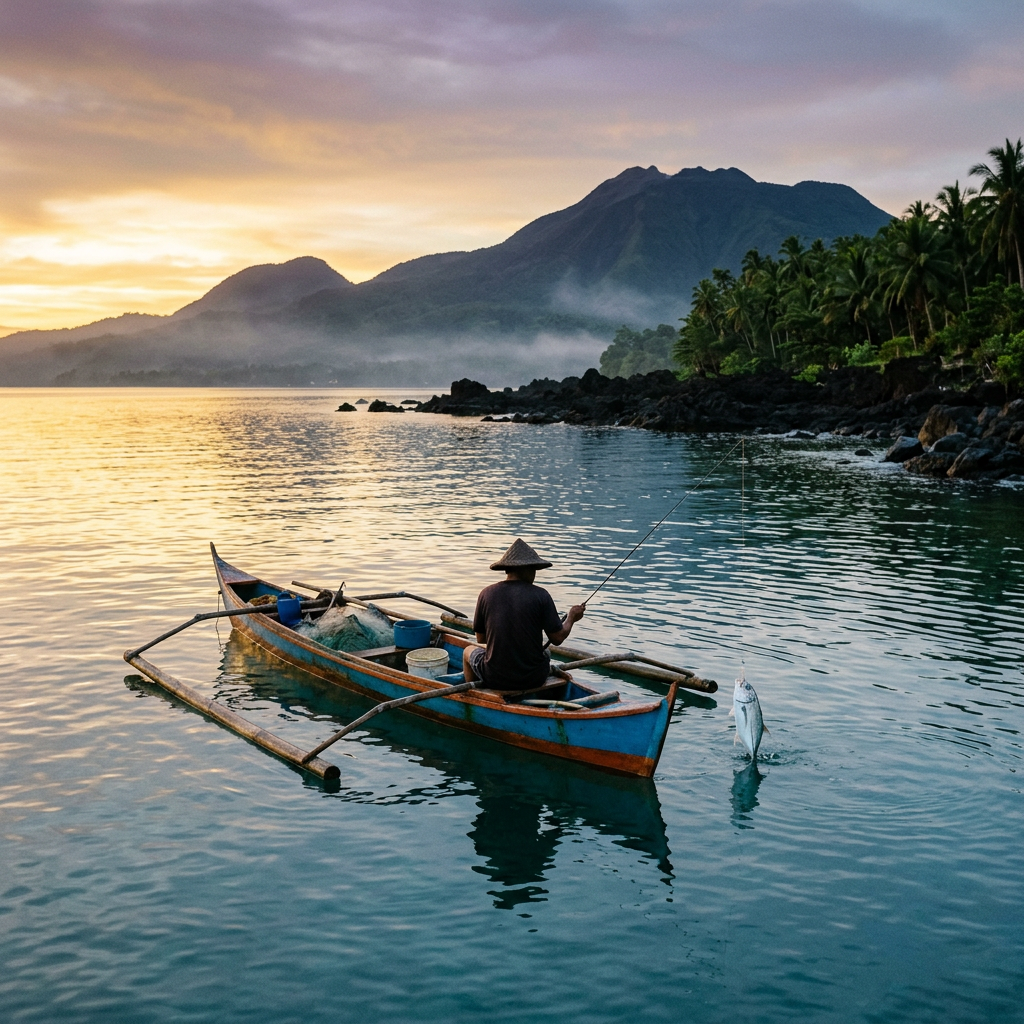
Hooked on Language is a memoir about how identity is shaped through the three languages of nature, culture and ancestry. In Hooked on Language, writer shares his experiences growing up on Camiguin Island where he learned about the ocean and its creatures as his first classroom where his father taught him patiently about fishing silently and humbly and listening to the nature. His first catch of a Takitok for instance became a symbolic event for him as he delved deeper into a world of listening and belonging.
Later on, the sea of Camiguin taught him the various species of fish and their respective shapes and sizes. His father taught him their names, their stories, their virtues, and their culture. He realized then that the word is connected to the land and the blood of my people. He was given my first dictionary—a practical book of the word of man and of his resources for livelihood, for observation, and for intimacy with nature.
His first true language was the Manobo tongue of his mother. It is a language that respects nature, culture and custom, values and ancestral wisdom. It is not just words to be spoken but a language to be lived.
Throughout the memoir the author concurring with his parents’ fears for the fragibility of indigenous languages and the urgent need to preserve them, the author gives a heart-felt personal tribute and call to action to all the languages which are part of people’s heritage today and which are in danger of dying and taking with them a whole universe of memories, identities and pieces of knowledge which will never come back again.
Hooked on Language is a memoir about belonging to a culture and a journey of listening, speaking and carrying on the heritage of a people and a culture of a place between the sea and the fish that his father taught him to catch and the language of his mother.

Memoir
CHAPTER ONE
Hooked on Language
The Day the Sea Taught Me to Speak
Adonis M. Awitin, Ph.D.
Hooked on Language
I — Hooked on Language: The Day the Sea Taught Me to Speak
I grew up in Camiguin Island. For us, the sea is not just water, it is our living elder. We can hear it speak if we listen. The smell of the brine in the morning and the ocean’s shimmering scorching heat on afternoons of summer are part of our lives. To us, the ocean is not just scenery. It is our food, our teacher and our companion.
My dad is a disciplinarian of the ocean, he is a fisherfolk and his hands may have hardened calluses on them and may have cracked skin but there’s so much life in them, so much geography in them that I would want to hold his hand forever. He never made us feel that he is a fisherfolk and that we are just his kids, he makes us feel that fishing is his responsibility and he takes it seriously every time he casts his line and retrieves it every time it gets pulled by a fish.
Every early morning, my dad would wake me up and say, “Anak, the sea is awake”. And off we would go to his favorite fishing ground. It was a bit of a hike but it was cool and damp and the sky was a deep purple in the east. The sea would be lying down and breathing loudly.
My father brought me to his favorite fishing grounds, a place in the sea where he said he could hear the Ocean whispering to him differently than anywhere else. It was not until I was a bit older that I realized what he meant.
Fishing with my father was one of the first wordless lessons I had, learning to understand a language of hand gestures, glances and silence. I learned to hold a fishing rod on my shoulder, to feel when a fish has been hooked on the other end of the line and to be patient for long periods of time without getting bored or complaining. I learned to pay attention, to focus and to observe without having to interrupt someone else. And I learned to listen, to pay attention to what someone else had to say.
I speak of those times of our quiet covenant. I speak of the times when we would go around the sea of dawn, the world mellowed, noise dissipated by the waters of the surf, all silenced in those huge cathedral of the ocean where silence is sacred.
Then came the day that changed everything.
My first catch of a fish was an incredible surprise to both my father and I. The fish took the bait and before I knew it, the rod bent sharply and began to tremble. I looked up at my father in shock as he sprang to his feet. He quickly grabbed the rod from my hands and exclaimed, “Go on, anak. Feel it.”
Eventually I wound the line all the way out into the depths of the epipelagic waters. The rod grew harder and harder to hold and seemed to be pulled in the opposite direction. The sun beat down upon my head and the water splashed against my face and dripped from the end of the rod as I struggled to reel in the fish.
My very first catch, a huge Takitok, a native fish of Camiguin Island.
The Takitok or Therapon camiguinensis is a species of fish found native to the waters of Camiguin Island.
Dad beamed with pride and even patted me on the back. “You did it, Anak,” he said. “You speak the language now.”
Ever since I brought home my first Takitok to my father, my passion for fishing has been endless. I go fishing all throughout my summers and just as I head back to school in the morning after, I just can’t wait to head back out to the sea. I am always outdoors whether I am in the water reeling in another fish or lying on the shore with my fellow anglers swapping stories of the ones we caught.
It changed my free time or leisure in general. I used to spend so much time at home during summer watching TV while I had so much more time to spend in the water and other things for leisure like fishing for example for long summers.
I speak of the waters of Camiguin. To those who are familiar with our island, the waters would bring to mind a dictionary of sorts of life. Each of the species found in the waters of our island has a name that stems from the municipalities and even the languages found on our land. There is Baksawan, Katambak, Kabalyas, Mansa, Budloy, Bagis, Lapulapu, Balo, Bodbod, Tikitiki, Molmol, Makabinhi, Lunab, Pagapa, Lambana, Bangus, Bangsi, Tulingan, Parotpot, Tabas, Bilong‑bilong,
Each of their names is a syllable of our identity — a syllable that has sprung from the land, the livelihood, and the lineage of our ancestors.
Language is not just spoken. Language is lived.
We are a poor tribe of indigenous Filipinos called the Manobo, the tribe of the indigenous of this land. Our language is so full of knowledge and experience that we have passed it down from generation to generation. I learned my first language from my mother. When I was crawling on all fours on the floor as an infant, my mother would say “Kona hipanaw ag lokonlokonan.” According to our language and culture, we were not allowed to ever kneel on our knees on the floor for fear that we would be cursing the elders to die. I had so much respect for the elders of our tribe that I never even thought of getting down on my knees and placing my weight on my knees.
Now, as I am in my 40s, I learned through my Western Medical Training that kneeling on one’s knees for prolonged periods of time can cause severe tibiofemoral osteoarthritis. This must be the reason why our ancient language decreed that children must not ever kneel on their knees lest they be cursing the elders to an untimely death.
The world is rapidly changing and languages are vanishing one after the other. Every two weeks, another indigenous language falls into extinction and with it a complete universe of knowledge, memory and identity is being lost for good. 40% of the world’s 6,700 languages are endangered according to UNESCO.
And yet, language persists where people persist.
Just like the Takitok fish, The Manobo tongue is alive today because someone somewhere chooses to speak it, to honor it and to hand it down to the next generation. The indigenous languages of the world are not relics of a bygone era. They are living, dynamic languages which embody the environmental wisdom, the cultural resilience and the deep ancestral truth of their speakers. Not only do the languages of indigenous peoples teach sustainable farming practices, the use of medicinal herbs, biodiversity conservation and a healthy ethics of community and of being in relation to other people, they teach their speakers how to belong.
They teach us how to belong.
Listening to the rod and line while fishing with my dad has taught me a great deal about how to listen to other things as well. And the language of the Manobo tribe that my mom taught me has taught me to speak a great deal as well. Fishing and the language of my tribe has given me the language of my life, the language of water, memory and identity. It was so very important when I felt that pull on the line and felt the weight of the water above me and saw that fish leap from the surface of the water and heard my dad’s loud laughter and felt his pat on my back. It was so very important.
It was not just a catch.
It was a calling.
There are many worlds within our own and they all speak in many languages: written, oral, visual and musical. My childhood summers spent on the ocean of my home state opened up many of these worlds to me and started me off on a life long love of language and culture and stories.
Good things come to those who bait!
Better things come to those who listen.
Memoir
CHAPTER TWO
Hooked on Language
The Ocean as Teacher
Adonis M. Awitin, Ph.D.
Hooked on Language
II — Hooked on Language: The Ocean as Teacher
The ocean was my first classroom. I began learning how to live before I ever entered a school, with desks and pens and books. My teacher on the water was my dad. I never really knew he was teaching me because he was just there, living in front of me, and I would follow him.
My father would set off ahead of me. His black shape would recede into the half light of dawn. I would follow behind him, trying to keep up with him as he strode along the beach. The sand would be soft in places and he would change his stride to accommodate it, but he would never draw attention to the fact that he was doing so. I would try to follow in his footsteps but it was impossible to replicate the subtle changes in his gait. He seemed to know every step of the way and I was content to follow in his wake.
On our way down to the shore, my father would stop at the water’s edge, scanning the horizon as if searching for something. Sometimes he would be lost in thought for a long time. I would ask him what he was looking for and he would reply that he was trying to read the signs the sea was sending him. To me the sea always looked the same in the morning – vast, shiny and seemingly endless. My father was different. He could read the currents, forecast the wind, even tell you hours in advance what the weather would be like. Yet he had never been a man to study the tides, to throw himself into the study of the sea. Instead he had learned everything he knew from his family.
“Listen,” he would say to me (there would be no sound of sea gulls, no sound of any kind of sea animal, no splashing of water–just the sound of the waves going in and out–) “The sea tells you what it wants.”
My initial idea of how to “listen” to the sea for what it wanted was that there would be a sound or a sign for me to hear on the shore while I was waiting. And at first, there wasn’t.
My father taught me that the ocean rewards those who pay attention.
He wanted me to feel with my whole body the weight of the line of the fishing rod and not only in my hands. After saying that he tapped my chest. “Feel the weight of the line”, he said. “Fishing is not a strongman contest. It’s patience”, he said waiting for me to get it.
Patience. This is the lesson that the ocean has to teach for many years.
We went out on many days and didn’t catch anything. As the sun reached its peak in the sky we would pack up and head to shore. My father never seemed to be in a hurry to leave. He would sit there for hours, staring out at the water as if he was focusing on a point somewhere on the horizon. I tried to sit there with him, to focus on the water as he was. But I was always impatient to get back to shore. I would sit for a while and then I would get up and try to leave. My father would call me back. After a while I would sit back down again. We would just sit there.
So, patience is not just sitting around for a while. It is awareness and trust in a situation and the possibility of growth in that situation.
Trust and patience. My father trusted the ocean, the fish, the process, and when he got out on the water he had complete trust in all of these things. And in the end I learned to do the same.
The ocean also taught me humility.
In really good fishing weather, we would catch loads of fish. But there were also days when the sea was obviously thinking and no matter how good a fisherman my father was, or how carefully we cast out our lines, we would return to the shore empty-handed. My father would just say that the sea was thinking on those days.
No matter what the sea did my father was my father never once lost his patience with it or with me. He never even seemed to get annoyed with it. He was a master at accepting the sea for what it was, and that was to say for all of us as humans for what we are.
Humility means to know that you’re not in control of everything, especially when it comes to nature and its elements that are so much bigger than we
The ocean is so vast and is something to be so respected and aware of. It can be so very generous and giving but also can be so very unforgiving and can cause so much pain to someone who does not treat it with the utmost respect.
Another lesson the ocean taught me was rhythm.
Fishing is a kind of dance. And I do mean each process of fishing over and over again: throwing the line gently into the water, waiting until a fish bites the line softly, pulling the line in slowly, pulling in the fish on the other end of the line slowly, taking the hook out of the fish’s mouth slowly and carefully, taking the fish off the hook slowly and carefully. I watched how my father could cast his line into the water so gently. I watched how my father patiently waited for a fish to bite his line. I watched how my father pulled the line in slowly and with so much control and patience. I watched how my father took the fish off the hook slowly and with so much control and patience. And I even watched how my father’s hands moved so smoothly in order to do these things. It seemed so effortless, as if he were dancing.
“Don’t fight the water,” my father explained to me on another occasion. “Move with it.”
After the fish jumped out of the water to continue its struggle on the other side of the line, my father put a hand on my shoulder. “The ocean is stronger than you. Always,” he said. I hadn’t known what to make of that. It hadn’t been a warning or a insult, just a truth.
This is not a warning to me but rather a fact.
I can rephrase this though to a more positive note. This experience taught me patience by trust in a process or activity. In this activity of fishing I did not have to sit idly by waiting for something to happen. Eventually the fish would come to us as long as we continued to participate in the process of fishing.
My father taught me greatest lesson out on the water, though. That lesson was how to connect with another human being. When I was out on the water with my father, we were two souls that shared the
It was a great bond between two men. On the water my father and my father’s relationship was not of father and son. Instead it was of two men out on the water, two souls in silence, anticipation, and then excitement and joy when the rod bent and the line would tighten. It was as if we were two friends playing a game or sport together. The relationship and bond between us was of great companionship and was a relationship that I had not experienced before.
My father knew that I would know when it was time to get ready to reel in a fish. He would just look at me and I would know. He would raise an eyebrow when he felt a bite and I would feel it too. And when I finally brought in a fish he would give me a soft smile and say well done.
You don’t have to be constantly talking to someone in order to have a connection to them. Simple presence, attention, and an open mind and heart are the fundamental building blocks of connection to another human being.
Being there. Being attentive. Being open.
When I went to school to study the aspects of language, culture and communication, I found out that my father had been teaching me the fundamentals of language all along. All language is made up of words, but words cannot be separated from feelings. They are embodied in body form. And language is a way of life, and therefore cannot be studied as if it were in books.
The ocean was my first teacher and my father my first guide. And in the time spent out on the water with him I was better able to understand the world, listen, communicate, and to be connected to others.
I still am drawn to any body of water – river, lake or ocean. These quiet times bring back the memory of the special times of my childhood with my father. The connection that I felt with him in those moments, and the lessons he taught me on how to listen, speak and connect with others.
Memoir
CHAPTER THREE
Hooked on Language
The Language of Fish
Adonis M. Awitin, Ph.D.
Hooked on Language
III — Hooked on Language: The Language of Fish
The sea also taught me a long time ago that there is a vocabulary to the Ocean. Not only is there a vocabulary of the current, tides, wind, etc of the Ocean, but more so there is also a vocabulary expressed by the creatures that live within it. And for every fish that resides in our majestic blue world, there is a name, story and a lesson for the identity seeker.
Before I got to know the different sea creatures and their corresponding names, I got to know them first from my dad who taught me the local name of each fish before I even started fishing for them. Camiguin fish are not just for eating; they are also cultural markers or tools for our tongue and language to refer to and speak of the places where we live. In the island, each fish bears the name of a particular place or town. Learning the name of each fish is also learning the names of the different towns and places in the island.
My father taught me to speak fish one by one.
My father would hold the fish in the sun to show off its brilliant scales. He would say Baksawan or Kabalyas, or more often, Bagis. I would repeat after him, and he would explain to me the word. Sometimes he would even write it for me. I would taste the word on my tongue. I would feel the weight of the word in my mouth. I would try to make the shape of the word with my lips, with my fingers.
The first fish I could identify was Takitok. This is a very small fish that one can eat in one mouthful. It is found in the volcanic waters of Camiguin. He explained that these fish are very shy, fast, and clever. And so, when we fish for this, we have to be very quiet when we cast our lines because they do not like noise. The practice of casting quietly as well as slowly drawing in our lines when we feel a pull on it made me realize how to be respectful to creatures much smaller and weaker than us.
But Takitok was only the beginning.
The Baksawan on the other hand is characterized by its yellow tail. There is this local belief that catching a Baksawan early in the morning would bring the fisherfolk good luck for the rest of the day. And so every time my father would land one in our bucket, he would exclaim, Ah the sea is so generous to us today!
Another fish my father taught me to catch was the Katambak. It is said to have a balance of night and day in its skin. My grandmother would always say that this fish has a powerful affect on a person and teaches them to have a heart full of balance – never too dark and never too light.
Next up is Kabalyas. It’s a huge white fish with a huge mouth and looks like it has just been shocked. Children love this fish as it looks like it has just heard the latest gossip. My cousins even say that this fish knows all of your secrets and that is why it has such a huge mouth as it has to hold all the gossip in it.
Mansa: a large white fish which commands respect whenever it is encountered by humans. My father got to catch a lot of these fish but I never got to see or experience any excitement or joy on his part. According to him, the sea only trusted him to go fishing on days when he could catch a lot of Mansa.
The next fish that my father taught me was the Budloy (boo-dloy). The Budloy are a rounded fish with a red skin on the bottom part of their body and a yellow tail. They are a mischievous fish that love to play with the fishermen. They love to nibble at the bait until the fisherman thinks that he has already caught one. Then the Budloy would suddenly dart off with the bait still in their mouth. The Budloy are so full of trickery that my father always had a lot of stories to tell about them.
The Bagis is a rough-skinned fish. It can be so stubborn to bring in the shore. I had to learn to hold the rod firmly and to anticipate at what point the fish would put up the most resistance. My dad said that the Bagis teaches the fisherman strength.
The other fish that my father taught me how to call is Lapulapu-the fish named after the famous hero from Philippine history. This fish is red in color with a regal look to it. Often caught by fishermen, they are brought back to shore and served during special occasions like dinner parties and big celebrations. My father would put these fish gently in the bucket where the other fish are kept. I can sense that he has so much respect for this fish and its lineage.
Balo – a long fish with solid flesh on it. This fish is dependable, and so predictable that it is a fisherman’s friend. It will come to you when you need it.
Balo. The long fish with solid, dependable flesh. My father would say that Balo is a fisherman’s friend. He is so predictable. Always comes when you need him.
And there was Tikitiki – a fishy round in shape with a huge mouth and thick scales, said to be an extremely noisy fish. In his day, the sea was home to many drama queens but none more so than this particular species.
Molmol – Big bodied fish with thick scaly skin. Tricky to catch not all the time. “Molmol teaches humility. Don’t get too proud of catching fish.” My father would say.
Makabinhi – A fish with black scales on its body. He is said to carry stories of the deep and my father was always very wary of this fish. When he did catch one he would never let me touch it unless I had first washed my hands. I always remember my father saying that we had to respect the deep.
Bantay Botbot – The Fish That Lives By The Botbot. In nature, Fishes that live by nature lives around the Botbot or sharp edged rocky formations of the sea. According to legend the Bantay Botbot possesses knowledge of secrets found in deep waters of the sea.
And there is also another fish which is also black in color but this time scaleless. He is a slow moving fish who goes about his daily routine of finding food very thoughtfully, slowly and quietly. He is a fish that we can all learn from and my idea of relating to this fish is to be slow and to rest a lot more. Let us all slow down and breathe more deeply and be more thoughtful of our actions in this busy world that we live in.
The Pagapa or Oil Fish is a round fish covered with thick black scales. He is a fatty fish and considered a comfort fish. Rich, filling and very very satisfying to eat the palate. My mother would cook this on rainy days. She would make soup with it and it would be so warm and filled with oil.
On the other hand there was the fish called Lambana. He was very much like the Balo fish that I previously talked about but unlike the Balo fish, he was very gentle and apparently children were very lucky if they were able to catch a fish of this sort whilst out fishing.
Included among these many species of fish was the Bangus or milkfish which the Filipino calls his national fish and which my father always spoke of with fondness for he said it tasted like home.
There was Bangsi, the flying fish.
I forgot to include the other fish he mentioned which were the Tulingan. My father always said that this fish teaches the fishermen to be always alert and to be ready for anything at any time.
There was another big fish called Parotpot which was a flat fish. He was white in color and scaleless thus he needs to be treated with so much care once he was caught off shore.
Another one that my dad loves to cook for dinner is Tabas, it is thick in scale and thick in flesh.
Bilong–Bilong: These small fish are usually found on the surface of the water. They are white in color, scaleless, flat and shaped somewhat like coins. It is said that catching a Bilong–Bilong fish will bring good fortune to a child.
The name of another fish is Espada or swordfish. This has a long and sharp body. My father was so cautious in handling this type of fish. He said that we should respect its blade.
And there are the huge, and very rough Panit. This fish is so rare that I have never seen a picture of it, and if I were to catch one then it would be like winning a contest.
Habasan – a huge fish, said to be a variety of Bagis which is very venomous. I never saw any of these around but my father would never let me touch any fish he said taught fear and that too was a lesson.
Ilak – Big stomachs and very fat and good for a feast as they are made up of lots of fat.
Other species of fish that my father taught me about include Lambo. He said that Lambo are whitish‑black in color with very large mouths. As I said earlier, this large mouthed fish puts up quite a show while splashing and jumping in the water when hooked. Because of this my siblings and I would laugh at him. His .
Kitong – a black skinned fish that’s very fatty. This fish is very much prized by the Filipino fisherman as it tastes great and is usually given to the elders of the community.
As I began to learn the names of these various fish I realized that there were lots of different fish and each one of them had a story to tell, each fish had its own history and every time one was caught it had a lesson to teach.
And now as I list the fish here, I have come to an amazing realization…
The ocean had given my people a language.
A language shaped by observation, by livelihood, by intimacy with nature.
A language that could not be separated from place.
Naming the fish was an act of cultural preservation.
It was a way of remembering who we were.
A way of honoring the waters that sustained us.
A way of passing knowledge from one generation to the next.
My father never said this aloud, but I felt it in the way he spoke each name—with reverence, with pride, with belonging.
The language of fish became my first dictionary.
My first cultural textbook.
My first lesson in how language grows from life itself.
And as I grew older, I realized that learning these names was not just about fishing—it was about identity. It was about understanding that language is rooted in land, in livelihood, in lineage. It is shaped by what we eat, what we fear, what we celebrate, what we remember.
The fish taught me that language is alive.
It swims.
It moves.
It adapts.
It survives.
And like the fish, it must be protected.
Memoir
CHAPTER FOUR
Hooked on Language
Mother Tongue
Adonis M. Awitin, Ph.D.
Hooked on Language
IV — Hooked on Language: Mother Tongue
As I grew up, I learned to speak the language of my mother long before I could ever hope to learn the language of the fish.
My mother’s voice taught me about the world and its many complexities, I learned about my tribe and my family before I even knew how to speak the language of fish, my mother taught me the language of the Manobo tribe, our family, our way of life, love. She doesn’t have to speak loudly because her voice already conveys the deepness of her thoughts and feelings, already has the intention and already is connected to something old, deep and sacred.
One of my earliest memories of my mom calling me was when I was a crawling toddler along the bamboo floor of our house. She would say “ Kona hipanaw ag lokonlokonan” and I would immediately stop in my tracks with my hands flat on the bamboo floor. She would then repeat it louder each time until I finally get up and she would pick me up and hold me in her arms.
All this was taught to us children by our mother long before we could even understand what it was all about. Our culture doesn’t allow elders to walk on their knees on account of the curse it brings to them and the ill that it brings to the tribe and the elders who carry the tribe’s knowledge and wisdom to the world. Children are expected to walk on their feet upright all the time, to respect their elders, and their culture and their lineage. Kneeling is reserved for prayer, for great respect, for extreme humility, not for play.
I also began to realize that there was so much more to walking on one’s knees than what I initially learned. For the Manobo tribe, walking on one’s knees is forbidden because it can bring a curse on the elders and bring misfortune to the tribe. Thus, children of the tribe are taught to stand up while they are still young. They are to walk upright like the adults in the tribe. Only during prayer time are people allowed to get on their knees. They do this with great reverence and humility.
My mother’s language was my first map of the world.
My mother wanted me to know the names of plants and be able to carry out rituals and be knowledgeable about the ways of our tribe. She wanted me to learn how to greet the elders of our tribe in the proper way and to speak humbly before older people. She wanted me to be a person who listened carefully to others and showed respect to others. She said that language was behavior, beliefs, and culture and therefore it is very important.
In our culture we have always taken a lot of care in using words. Words have always been meant to be spoken with intention, with history behind them, and roots in the earth. My mother carried all of that with her in her voice. She was not just teaching me how to speak when she spoke, she was preserving something fragile, something precious, something that could easily disappear if not passed on.
I cherish the memories that I spent with my mom during the late afternoons when she would weave baskets or sort the grains of rice that we had harvested from our farm. Most of the time, she would be humming a song in Manobo while she worked. The songs were simple and she would repeat the lines over and over again. Although I did not know what the songs meant, I could sense the emotions that they evoked in her. There was a longing in some of the songs, pride in others, and a sense of struggle to survive in this world that we live in. These songs brought back memories of the past and stories of our people’s history without the need of reading a book and turning the pages with ink on them.
She would also tell me of our ancestors. She would speak of the great warriors and of the great women who would venture into the forest to gather certain plants and trees in order to make medicine. There were also the elders of the tribe who were very wise and could interpret our dreams. And then there were the spirits that lived in the mountains and those that lived in the rivers and the many rituals that we as a tribe would hold in order to pay respect to the earth.
“Language is memory,” my mom once said to me. “If we stop speaking, we forget who we are.”
But as I am getting older and more aware of the world around me I am shocked and appalled by the rate at which the languages of the indigenous peoples around the world are dying, two weeks for the extinction of every language. The reason for this fear is that each dying language will take with it not only the centuries of memory of the tribe but also the traditions, stories, songs and behaviors that define the identity of that particular tribe and also that each language is part of humanity as a whole and therefore the loss of any language will mean the loss of a part of human identity as well.
My mother knew this a long time before the reports from UNESCO started coming out. She knows deep within her bones the fragility of our language and the slow dying of our culture. She sees how the young generation of today are so used to speaking in the dominant language of the country and soon they would forget the words of their heritage. She also sees how the elders of today are slowly fading away and taking with them the stories of our ancestors unrecorded in books.
Her urgency made sense now.
“Kona hipanaw ag lokonlokonan” is more than just a warning. This is a plea for respect, for tradition and most importantly for the preservation of our language.
My understanding of the role of language in our daily life also grew as I grew older. For one, greeting elders in our tribe with the proper respect by addressing them with honorifics in our language and with the proper body gestures is very important. For children, speaking with humility and respect to the elders by speaking softly and choosing the right words is important to avoid offending them. Sometimes, even for adults, choosing the right words to avoid boasting or giving offense to others is important. In our tribe, sometimes words can even cause discord to the community, which is why we choose our words very carefully.
I think that my mother has tried her best to learn the language and the ways of our tribe and culture. She treats everyone with the utmost respect, and always speaks with the greatest of clarity, gentleness and purpose. Even though I am older now, I can still be learning from her words, although they are few. It always amazes me that even when she is scolding me, her words are laced with so much love. Sometimes, I even feel fear mixed with respect towards her and the elderly, and I know that this is how it should be. She is just trying to preserve the respect that our tribe has for the elderly and God. She believes that language is a very powerful tool, and I am very grateful to have her as my mother.
On one evening while I was still young, my mother and I went outside our home as the fireflies started to emerge from the grass all around us.
“Every language has a soul,” my mom once said to me. “Some people forget that. But if you listen closely, you can hear it.”
What does the soul of the Manobo language sound like, I asked her.
The mother paused, her eyes half-closing as she looked off into the distance. The fireflies had all disappeared by now, but the embers of the fire cast a flickering glow over the dark grass where we sat.
It was simple and embodied the depths of meaning that language held for the generations past and present and future. My mother was expressing the emotion that language evoked in her – a sense of home and belonging to a particular way of life that was expressed through language. My mother’s words conveyed the fact that language was more than a sum of words and sounds; it was a collection of a people’s emotions, memories and identity of the past and present. It was the manner or way a people saw or perceived the world; it was a means of expression whether in times of happiness or in times of sorrow. It was also a means of storing a people’s collective wisdom and knowledge that would be passed down from generation to generation through their language.
When I read about language acquisition and how a language and culture is transmitted from one generation of speakers to the next, it all makes sense to me now. My mom seemed to have this intuitively, but of course she never read any of the books on the subject either. She just lived it.
She understood that language is lived.
We can bring a language back to life! The language can disappear but can be spoken again! Language is lived.
My mother chose to speak it every day.
She spoke it when she called me to dinner.
She spoke it when she warned me of danger.
She spoke it when she comforted me after a fall.
She spoke it when she prayed.
She spoke it when she sang.
She spoke it when she told stories of our ancestors.
Her voice was the thread that connected me to my heritage.
And now, as I look back on those moments, I realize that my mother’s language was not just a part of my childhood—it was the foundation of my identity. It taught me how to listen, how to respect, how to belong. It taught me that language is not just spoken—it is lived.
The ocean taught me patience.
My father taught me rhythm.
But my mother taught me meaning.
She taught me the soul of language.
And that soul lives in me still.
Memoir
CHAPTER FIVE
Hooked on Language
When Languages Die
Adonis M. Awitin, Ph.D.
Hooked on Language
V — Hooked on Language: When Languages Die
When I first found out that language can die I had no idea how fragile language is.
As a child, I grew up believing that languages are eternal. Like the mountains, like the oceans, like the sky, languages exist forever. The words my mother would say to me are always there. The stories of our elders are always being retold and told to children for generations and generations. We would preserve these stories and languages like relics in a museum or like heirlooms in a box that we would pass down to our children. I had never even thought about the possibility of languages dying.
But languages die quietly.
Language extinction occurs slowly. Sometimes you can’t even remember when it began. The children of today speak their mother tongue less and less while growing up. If they still do speak it, they will only do so when they are older. In the meantime they speak the languages of the dominant groups in their country or in the world, as well as English, with their friends. Young people, growing up in a given environment, adapt easily to the language or languages of that environment and in time start to use them as their own in their daily communication with their friends. For this reason, even when they still understand a lot of their mother tongue, the words and sentences of that language are no longer enough for them in their daily conversations and interactions.
I first found out about the dying of languages when I noticed how fewer and fewer of the children of our community spoke fluently in Manobo. Yes, they still recognize the language and even know some of the words and phrases. But the majority of the children in the community nowadays speak Cebuano, Tagalog, or English. They even have their own little conversations amongst themselves and their laughter sounds familiar but not the same as when they speak in Manobo.
At first I did not even give a thought to this. Children can easily adapt to what they are constantly surrounded with. But recently I was sitting near the river to read a book and children were playing around me. After a while I put the book away and went to watch them. As I was watching them I realized that all the time they were speaking Cebuano and not even a single word of Manobo.
It felt like watching a thread snap.
I remembered my mother’s voice and words, I remembered her warnings, her songs and stories. I remembered what she said to me about language and that is language is memory. And if the children of our community are not speaking in Manobo anymore what memories will they have? What stories will they be told? What identity will they have?
The thought unsettled me deeply.
Reading about global language extinction really brought home the reality of what’s happening to languages and cultures around the world. Every two weeks a language, culture and way of looking at the world dies off forever. With 6,700 languages in the world 40% or 2,610 of these languages are in danger of falling out of use. Many of these languages are from indigenous cultures and communities. The languages of these cultures hold a great deal of knowledge regarding herbal medicine, farming practices, ecological wisdom, spiritual practices and the history of a culture and its people.
There are many endangered languages spoken by indigenous communities all around the world. For people like us, language is closely tied to the land where we live, our livelihood, and our lineage. Thus, when a language is lost, there is a great risk that knowledge and skills will be lost about how to use plants for medicine, how to farm, how to live in harmony with nature, about one’s spiritual practices, and the stories of one’s ancestors.
It meant losing identity.
And beyond the mere number of languages spoken by people of various ethnic groups and the subsequent loss of culture and the identity of the community, it was the passing of the voice of the mothers and the elders, of the memories that the children of a community had of growing up within that community and of hearing the stories of the tribe’s and people’s elders.
These are very wise people, and it is very sad that their knowledge and stories will die with them. I had a great deal of respect for the elderly man, Datu Lantoy, who was happy to tell me of the stories of the tribe’s origin, of the battles they had fought, of the rituals they performed, and of the spirits that they still believed in today. I asked the younger people in the tribe if they knew these stories, and they said they knew some of them, but not all. He was worried that the stories of the tribe would die out and that the culture of his tribe would cease to exist.
I once had the chance to sit down with an elder of our tribe, a man by the name of Datu Lantoy. The man was a gentle soul, a lover of peace who had lived through his fair share of wars. But what struck me most about the man was his storehouse of knowledge regarding our tribe and its many customs. I would sit for hours listening to him regale me with stories of our tribe’s beginning, of the wars that our tribe fought and lost, of the rituals that we still perform today for our many spirits. The man had an incredible memory, recalling even the smallest of details regarding the many stories that he would tell. But one thing that really struck a chord with me was when I asked him if he thought the younger generation today knew all of the stories that he knew. He looked at me with a deep sadness in his eyes and replied, “They know pieces.”
“Do they know the stories of our tribe’s origins?” I asked him. “Do they know the stories of the battles that we have fought and the rituals that we
He looked out at the mountains far away. “A language does not die with the last speaker of it,” he said. “It dies with the last listener of it.”
His words pierced me.
Language death is a non-linguistic issue, it’s an emotional and psychological issue of a culture and whether the people of that culture are willing to take time to preserve their heritage and continue to speak their language to their children.
I thought of my mother and her words. I thought of my father and the way he respectfully called fish by their name. I thought of the powerful ocean, and all its might. I would look at the children playing by the river, them laughing and speaking in our native tongue for a moment, then I would be snapped back to reality. They would be speaking Cebuano.
And I felt a quiet grief.
Language death is generally not dramatic and will mostly happen as a result of the many small decisions an individual makes on a daily basis. Speaking in the dominant language of a country can be convenient and using a few familiar words instead of whole sentences to communicate with others can be easier then struggling with words and grammar of an old language that is no longer used in everyday life. It can be very hard for older people to speak in an old language when they are no longer used to. As a result, the language of their parents and grandparents will die, not dramatically, but slowly, until no one speaks it anymore. It dies with the last speaker, but it dies a long time before that. It dies with the last listener.
But usefulness is not the measure of value.
A language is valuable because it carries identity.
Because it holds memory.
Because it preserves worldview.
Because it connects generations.
Because it is a home for the soul.
I learned that when a language dies, it takes with it:
stories that were never written
songs that were never recorded
rituals that were never documented
knowledge that was never translated
wisdom that was never shared
It takes with it the laughter of ancestors, the prayers of elders, the dreams of children. It takes with it the way a people understand the world.
And yet, despite this immense loss, language death often goes unnoticed. The world moves on. New languages rise. Global tongues dominate. Technology accelerates communication. But something irreplaceable disappears quietly in the background.
I began to see language death everywhere.
In the way elders paused before speaking, searching for words they feared younger listeners would not understand.
In the way children responded in Cebuano even when spoken to in Manobo.
In the way cultural rituals were shortened, simplified, or abandoned.
In the way stories were told less frequently.
In the way silence grew where language once thrived.
It felt like watching a shoreline erode—slowly, steadily, inevitably.
But grief is not the end of the story.
Because even as languages die, people fight to keep them alive. Communities gather. Elders teach. Children listen. Scholars document. Governments recognize. Activists advocate. And individuals—ordinary individuals—choose to speak, to remember, to preserve.
I realized that I was one of those individuals.
My mother’s voice lived in me.
My father’s lessons lived in me.
My tribe’s stories lived in me.
My island’s language lived in me.
And as long as I spoke, as long as I remembered, as long as I cared, the language would not die.
Languages die quietly.
But they can also be revived quietly.
One speaker at a time.
One story at a time.
One child at a time.
One choice at a time.
And so, I made a choice.
I chose to speak.
I chose to remember.
I chose to preserve.
I chose to carry the language forward.
Because when languages die, identity dies.
But when languages live, identity lives.
And I wanted ours to live.
Memoir
CHAPTER SIX
Hooked on Language
The Fight to Preserve
Adonis M. Awitin, Ph.D.
Hooked on Language
VI — Hooked on Language: The Fight to Preserve
Pain. I wept for the languages that are dying and for the world-view, the memories, identities of peoples that are going to disappear with them. The pain was not of the type one feels when a person has gone and one is mourning for that person. It was not even of the type one feels for a place or for a country that one had left and is no longer there. No, it was a pain as if a part of the world itself had been taken away and was never going to be there again. But as with all things, the initial pain gives way to responsibility, and the responsibility to act. And when one acts with love for the person, place, situation or group that one is serving, then that action is called preservation.
Saving a language does not start in meetings or in offices of government institutions. Saving a language starts in the homes of speakers of endangered languages. These are the kitchens where a mother speaks her children in their native language. These are the fields where an elder speaks his or her native language with fellow workers picking fruits and vegetables for a living. These are the boats where a father and his son go fishing and each time they catch a fish, they name it in the native language of the community. All these places and more is where a language is either being saved or lost. And it starts with someone choosing to speak in their native language even when it is more convenient not to.
My fight began with a choice.
I started speaking Manobo was when I chose to preserve our dying language. Even if nobody else wants to speak it, I try to speak it. I try to greet our elders in our language even if they reply in Cebuano. I even try to ask my questions in Manobo even if my peers get annoyed at me saying that it is an old language and not practical to use it. I remember the words that my mother whispered in my ear, the stories that my father told me, and the names of the fish that he called as he pulled them in from the sea.
Preservation of a dying language is not enough to save it; someone must teach it to others.
I started teaching the younger cousins of mine to name the fish that my father and I catch in the river by their side. We would tell them the stories of Takitok, Baksawan, Kabalyas, Bagis, and Lunab. I would explain to them the meanings of their names, and how each and every one of the fish that we catch carry with them the identity of our people and the history of our tribe as we catch them. At first, the cousins were curious to learn the names of the fish. Later on, they felt proud of themselves to be able to name the fish that we catch as well. And later on, they even were able to remember the names of all the fish that we catch as we wade along the riverbank.
This summer, I have the chance to spend time with my younger cousins, all under the age of 14. They all have very different personalities, but the youngest of them all has to be the most curious and restless child I have ever met. Last summer, we would spend our afternoons at the beach, and the boy would be throwing stones into the water and then running after them in an instant. Every now and then, he would catch a fish and then bring it to me to ask what it was. At first, I would tell him the name of the fish, and he would repeat after me. After a while, he would be able to say the name of the fish on his own. It was really impressive. One afternoon, we were sitting on the beach, and he asked me why the fish had so many names. I told him that names are not just labels given to things, but also stories about them. They are also memories of the past, and a way of honoring the land and the sea that gave them life. He thought about it for a moment and then said, “So if we forget the names, we forget the stories?”
“Then we shouldn’t forget,” he said after a moment.
The little boy looked out at the ocean with the sun sparkling on the water. “Then we shouldn’t forget,” he said.
For him it seemed so obvious, as he looked out at the ocean. He sat across from me, in the shade, his small frame was so intent on hearing what I had to say, as if the weight of all that I had just shared with him was suddenly lifted off his shoulders. I had been sharing with him how languages and cultures were precious and that many were dying. It never occurred to me that I was sharing something so important with him, but that awareness or the understanding of this is the very first step towards preservation. And if the children are growing up with this awareness then they can also be the protectors of their languages.
But preservation also requires community.
After a while, I began joining in on various gatherings where the elders would share their experiences and stories about our ancestors, various spirits within our tribe, and different rituals and traditions that we, as a tribe, follow. In order to preserve their stories, I recorded them. At first, I didn’t have any technology such as digital recorders, so I memorized their stories in order to retell them to others later. And as time went by, I started writing them down as well, fearing that if I didn’t do so, their stories would be lost forever.
Elders were also initially hesitant because our stories have traditionally been shared orally among a group of people and feared that having them written down they might make them stiff and lifeless. However, after a while, the elders were more than willing to share their stories as I wrote them down.
Workshops for indigenous language preservation. Items they were selling ranged from books on how to document endangered languages, teaching aids and learning materials to revive endangered languages, youth camps where children and adolescents can learn to speak the languages of their ancestors, and various tools which can be used by applying linguistics to real-life situations. These workshops and !shops (workshops conducted by !shops participants and other people concerned about the preservation of the world’s indigenous languages) proposed a plan of action for saving languages on the brink of extinction. Most of the plan involved the indigenous communities themselves and also required.
Of course it’s the elders who have done the most to preserve the language. One of them recently told me, “We don’t need to be saved. What we need is for people to speak our language.”
One elder agreed with me, saying that, “We don’t need saving. Our language needs speaking.”
“Teach the children. If the children speak, the language lives.”
This realization made me realize how preservation of language is a living practice, archiving of language is not equal to preservation of language, creating of repositories of word and sound is not equal to using of the word and sound in daily conversations and in practical life, that is to say that preservation of language is equal to creating of speakers of the language.
Preservation also requires courage.
Being public with our Manobo language is very mortifying to me. People stare at me and I don’t know how to deal with them. Sometimes I don’t know if I am in the right place too. There are times I even wonder if I am doing anything worthwhile at all. The memories of my mom’s voice, my dad’s lessons, the stories of my tribe bring back those kids by the river speaking in a language that is not our own. And there are those elders who are slowly losing their voice.
And I spoke anyway.
It is a quiet act of heritage over convenience, of identity over assimilation of memory over silence.
Preservation also requires creativity.
Lately, I have been experimenting in weaving in Manobo words to my poems, essays, and stories about fishing, language and culture and identity. I hope to create new stories to remember, to preserve, and to honor.
Right now, I am trying to teach children about the spirits that inhabit the mountains, about the river guardians, and about the ancestors of our tribe. I tell them the stories of these events and I make sure to use the corresponding Manobo words while telling them. While they listen with wide eyes and wonder, they repeat after me the Manobo words that they learned from the stories that I told them. They ask for more stories and even laugh heartily while listening to them. They learn a lot from the stories that I tell them too.
Storytelling became a tool of preservation.
But preservation also requires advocacy.
Speaking in public about the need to preserve the language and ensuring that the language is taught in schools is also important. I have worked with organizations here and abroad, providing them with information on the importance of preserving indigenous languages and cultures. In the past, I worked with organizations that implemented programs and projects that aimed to preserve the culture and language of the Manobo. Most of the programs and projects that I worked with dealt with the language rights of speakers of indigenous languages and their identity as members of their cultures.
In sum, advocating for the saving of a language and/or culture is not about yelling from the top of your lungs and trying to get people to notice. Rather, it’s about inviting people to take a look, discover more about the language and culture of others and hopefully realizing that what they have is something valuable and worth appreciating.
Preservation also requires hope.
Every now and then some days are harder than others. There are days when I feel somewhat embittered and some other days when I am profoundly saddened. Some days I am dismayed that some of the children in the area speak in the language commonly used by the majority of the population instead of our own language. Occasionally, an elder of ours departs this life without any of his/her stories having been recorded. Now and then I wonder whether or not all of our efforts will be for naught.
But hope persisted.
Hope lived in the children who asked questions.
Hope lived in the elders who continued to speak.
Hope lived in the parents who taught their children.
Hope lived in the community gatherings.
Hope lived in the stories.
Hope lived in the songs.
Hope lived in the ocean.
Hope lived in me.
Saving a language is not a short term campaign but rather a long term commitment, a daily choice and a collective effort. It is a love story between a people and their identity, between a community and their heritage and between a child and their mother tongue.
And I chose to be part of that love story.
Because languages die quietly.
But they can also be saved quietly.
One speaker at a time.
One story at a time.
One child at a time.
One choice at a time.
And I chose to fight.
Memoir
CHAPTER SEVEN
Hooked on Language
Returning to the Water
Adonis M. Awitin, Ph.D.
Hooked on Language
VII — Hooked on Language: Returning to the Water
Until recently, I had no idea how much the ocean was a part of me until I had left it.
After leaving the ocean to go to school, to grow up, I thought I had left that aspect of life behind. I thought that as I grew up life would follow a steady, predictable course – classes, work, responsibilities – and that I would be fine. I would miss the ocean and its pull on me, but I would be adapting to new situations and learning to speak new languages, returning to memories of long ago like a tide pulled up to a beach, pulled back by some unknown force to once again make its way back to the sea.
Years went by and I went back to Camiguin. The island was just as I had left it when I was a kid. The air was warm, the sky was vast and open and the ocean was still sparkling and ancient. I felt like I had to return to a language that I had long forgotten and was afraid that I had lost for good.
But the ocean remembered me.
It always does.
Walking down to the shore, I sank into the cool sand with every step. The water lapped around my ankles. I closed my eyes and soon I was back in sync with the waves lapping at the shore. I swayed back and forth with the ebb and flow of the tide. The sound of the waves was so familiar and seemed to wash over me like a warm hug. The whispers of the wind seemed to carry the same messages that my father had once tried to hear the sea convey to him. I felt my body and soul relax into the same rhythm as the sea and I was once again breathing in and out to the calm and steady beat of the ocean as it had taught me all those years ago.
Before leaving the island something that had been wound up tightly and had been slowly coming untight while I was leaving the island to return to the island would be finally released by the sea. The sea is not only a place where one grows up, the sea is a memory, a teacher, a home.
My dad isn’t as young as he used to be. His hair is thinner now and he’s older and his steps are slower but there is still that same deep wisdom in his eyes. When he saw me standing by the shore he immediately smiled in the same deep way that he used to when I was a little girl.
“You came back,” he said.
“I had to,” I replied.
Dad smiled knowingly. “The sea calls its own,” he said.
We went to the fishing spot my dad used to take me to all those summers ago. The path had changed since I last saw it – there were now more rocks, fewer trees than before – but it felt exactly the same as I trudged behind my dad. We finally arrived at the ocean’s fishing area and I was amazed by how much it looked exactly the same. I had expected it to be totally different, but instead, it was just the same. My dad handed me a fishing rod. I felt a sudden rush of excitement and, at the same time, apprehension. What if I forgot how to fish? What if I was really bad at it?
“Try,” he said.
The first line went out okay. It felt a bit awkward at first but as I sat there the muscles in my arms and shoulders began to relax and remember the motion of casting. The rod felt heavy in my hands and the line arced out through the air until it landed with a soft plop in the water. I felt the tension in the line as it sunk down into the depths and I felt anticipation build as to what might be on the other end of the line.
It was as though no time had passed.
As I sat there quietly next to him I felt the same silent communication that we had for so long. He was staring out at the water in front of us and I was staring at him. I was looking at the lines on his face, the tremors in his hands and the way the breaths of air he was drawing into his lungs were getting slower and slower. He was getting older. But the sea made him timeless.
After a while, he spoke.
“Do you remember the Takitok?” he asked.
I smiled. “ How could I forget?”
He chuckled at that memory. “You were so excited. You almost fell into the water.”
I had never felt such excitement to catch another fish. It seemed that that moment of catching a Takitok marked a new era in my summers at the sea and it was not just about fishing anymore. It had given me a new language and a new identity, the identity of belonging to a tribe and to a mother tongue and to stories of the past.
We went back to fishing for the remainder of the day. The minutes turned into hours, and the hours felt like an eternity. But even though we were there for so long, the ocean was still so gentle and so patient with us. It was once again so eternal. I was at peace. I had felt this way as a child when I felt like I belonged to everything around me, the same feeling I got while fishing as a child.
Eventually, the rod bent.
The line tightened.
I nodded at my father as I worked the fish back towards the shore. His eyes did not waver from mine, as if he was waiting for something from me – something more than just bringing in this fish. But I didn’t know what he wanted, and I didn’t know how to get it for him.
This small fish put up quite a fight for a small fish and I spent some time reeling it in – losing focus here and there, but my father could see the struggle and effort I was putting into trying to reel it in. And he could see the focus return as I began to remember how to do this and move with the water instead of fighting it.
And then it was there, leaping out of the water in a flash of silver and after a few more violent wriggles collapsing quietly at my feet on the sandy beach.
As I held up the silvery fish my father nodded in approval. “You speak the language still,” he said.
“You speak the language still,” he said.
The warm feelings of pride in remembering and gratitude in knowing that my memories of the ocean, of my dad, and of our language, our mother tongue, and of our tribe and of the stories that I grew up with will be passed on to our children. It was so important to me that we kept what was so important to us.
Returning to the water returned me to my identity and to something of my childhood. I know that identity is not something that can be left behind as one grows up. The physical distance between a person and their tribe is never sufficient to separate a person from their identity. Identity is always with a person and as I returned to return to the water and to my father was to return to the presence of the ocean and of the memories that this place held for me and for my tribe.
My dad and I sat in silence for the rest of the day. As the sun began to set we could see the waves moving across the water in slow motion. The fading light of day gave the ocean a sense of majesty and serenity and I felt a sense of peace and gratitude to be sharing this time with my dad.
Returning to the water and casting line into it, of course, is a physical activity but it also has deep spiritual implications for me. Returning to the water of my childhood has brought back memories of heritage, language and above all identity. The wonderful stories from my childhood have not been erased by time, rather they have grown and evolved and in returning to the water of my childhood, become anchors in my life when the tide of life is moving in unexpected and changing directions.
The ocean had taught me patience.
It had taught me humility.
It had taught me rhythm.
It had taught me connection.
It had taught me language.
It had taught me identity.
And now, it taught me return.
As the last light faded, my father stood and stretched. “Come,” he said. “Let’s go home.”
I looked at the ocean one last time, feeling its pull, its memory, its voice.
“I am home,” I whispered.
And I knew it was true.


Leave a Reply